
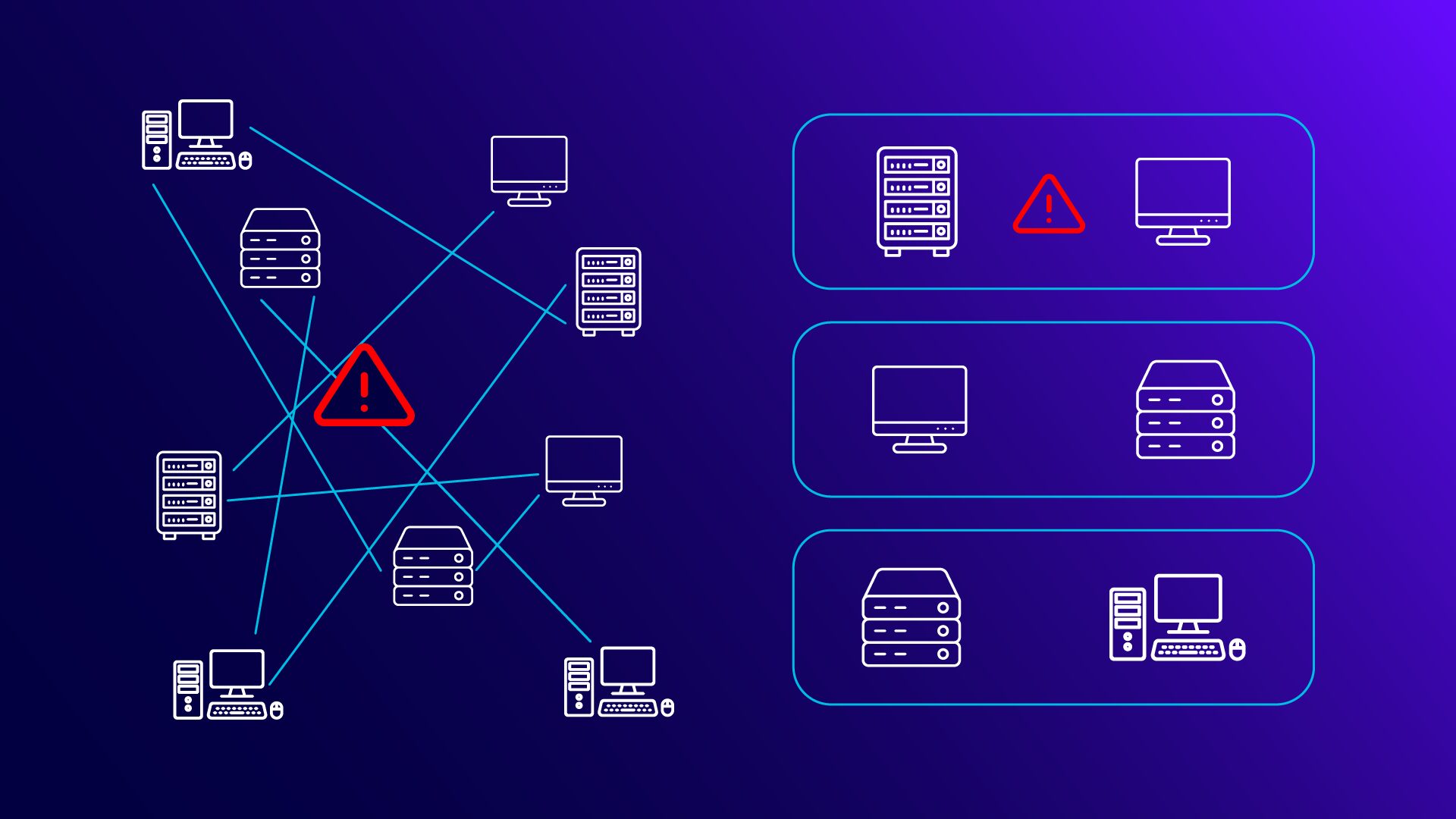

In today’s digital landscape, organizations face escalating threats from increasingly sophisticated cyberattacks. Ransomware, in particular, has become a leading risk, capable of crippling entire businesses within hours. At the heart of the problem lies a common architectural flaw: the flat network.
The risks of a flat network
A flat network is essentially a single, open environment where all users, servers, and services coexist without boundaries. While this design offers simplicity in management, it creates a dangerous reality: once an attacker gains access to a single machine, they can freely scan, move laterally, and compromise critical systems.
Research shows that in 2024, the average time it takes ransomware to spread in a flat network is under three hours. What begins as a small breach can quickly escalate into a full-scale business crisis, with data leaks, operational shutdowns, and soaring recovery costs.
Segmentation as the solution
Network segmentation addresses this weakness by dividing the network into isolated segments. This ensures that if a breach occurs, the damage remains contained to a single segment, preventing full organizational collapse. Beyond limiting damage, segmentation also:
- Reduces costs of incidents and accelerates recovery.
- Enables different security rules based on sensitivity (e.g., isolating critical databases from general services).
- Improves visibility and detection of abnormal traffic.
- Supports compliance with regulations like ISO 27001, NIS2, and PCI DSS.
In short, segmentation enhances both security and resilience, allowing businesses to keep operating even in the face of a localized attack.
Implementing segmentation
Segmentation can begin with basic separation methods such as VLANs and ACLs, and evolve into more advanced controls using firewalls, monitoring, and Zero Trust principles. A successful rollout requires:
- Mapping data flows and understanding “who talks to whom” in the network.
- Pilot projects to gradually test policies before scaling.
- Continuous monitoring using tools like SIEM and EDR to detect anomalies.
This step-by-step approach ensures organizations don’t just install segmentation but actually enforce and sustain it effectively.
The link to zero trust
Segmentation is also a cornerstone of the Zero Trust model. Zero Trust assumes no inherent trust within the network—every access attempt must be verified. Without segmentation, even the most rigorous Zero Trust policies fall apart in practice, as attackers can move laterally across the network once inside. Segmentation establishes the internal boundaries that make Zero Trust real, not just a theoretical framework.
Flat vs. Segmented: A clear difference
- Attack spread: In flat networks, ransomware can disable the entire organization. With segmentation, damage stays local.
- Visibility: Segmented environments provide clear traffic monitoring, while flat networks obscure communication flows.
- Resilience: A single failure in a flat network can paralyze many systems; segmented networks keep unaffected systems running.
- Compliance: Segmentation simplifies proving compliance with ISO, NIST, and GDPR standards.
- Cost impact: While segmentation may increase complexity in day-to-day management, it drastically lowers damage costs in case of an incident.
Final thoughts
As organizations adapt to modern threats, network segmentation is no longer optional—it is essential. By isolating critical assets, improving visibility, and enabling Zero Trust, segmentation transforms cybersecurity from a reactive defense into a proactive, resilient strategy.
The cost of not segmenting? Potentially catastrophic. The benefit? The ability to withstand attacks, continue operations, and safeguard trust in an unpredictable threat environment.


